
How to Search Cases by Name
Begin with the Wisconsin Circuit Court Access simple search, known as WCCA. It takes last, first, and middle names, or a business name. The county box defaults to statewide. Pick Sauk to narrow a common name. A date of birth can sharpen the results. Save it for when you truly need it. After all, a shared name alone proves nothing about identity.
- Open WCCA and read its use notice.
- Enter a last and first name, or a business name.
- Select Sauk County and add only a sound extra field.
- Compare caption, county, filing date, and status.
- Open the likely case and record its full number.
The empty official search form shows the field layout without exposing live case details.
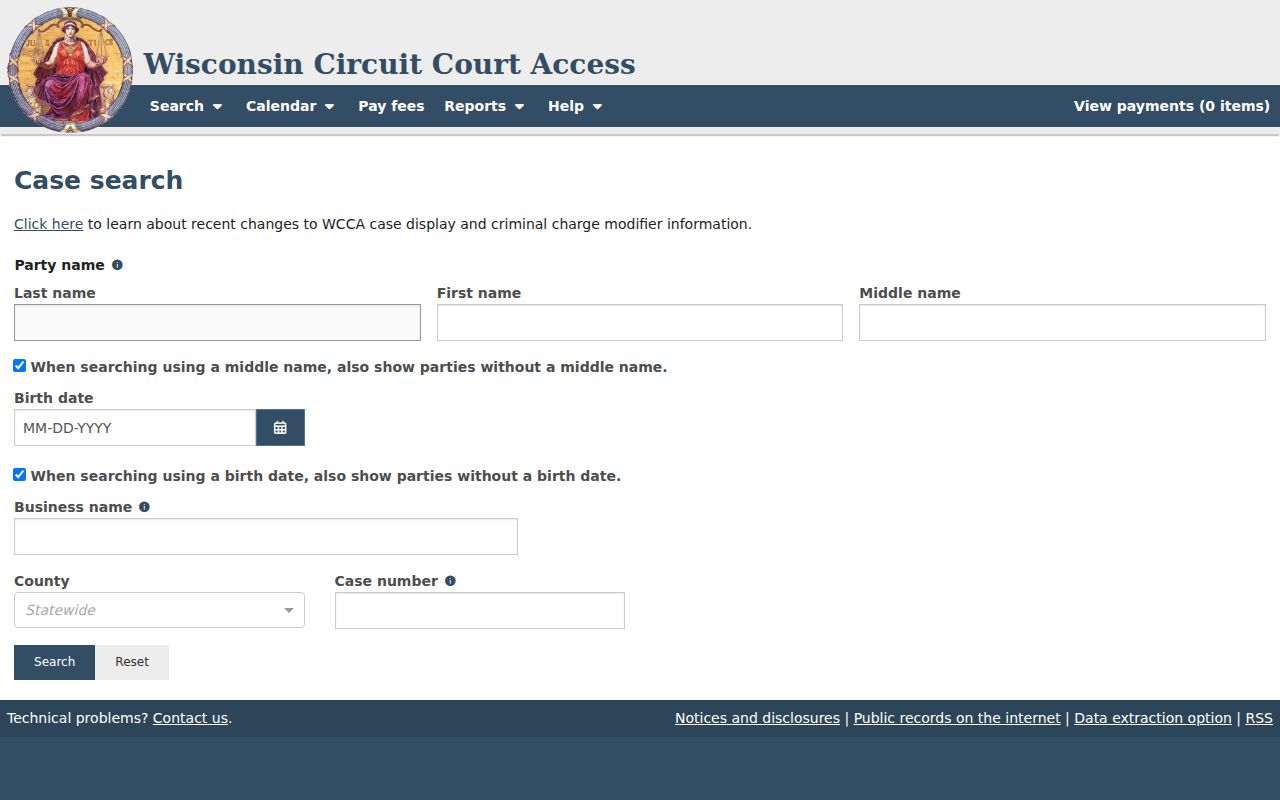
Use the separate person, business, county, and case-number fields. They keep a broad query from turning unreliable.
| Field | Type | Use |
|---|---|---|
| Person name | Text | Party search |
| Business name | Text | Organization search |
| County | List | Choose Sauk |
| Birth date | Date | Optional refinement |
| Case number | Text | Exact local case |
Sauk County Advanced Search Controls
The WCCA advanced search offers many filters. Choose class code, case type, status, or filing and disposition dates. It also takes State Bar ID, district attorney number, offense date, issuing agency, citation number, and case-number range. A filing-date search spans thirty days at most. Pick a case type and you must add another accepted criterion. Those limits often explain why a search comes back empty.
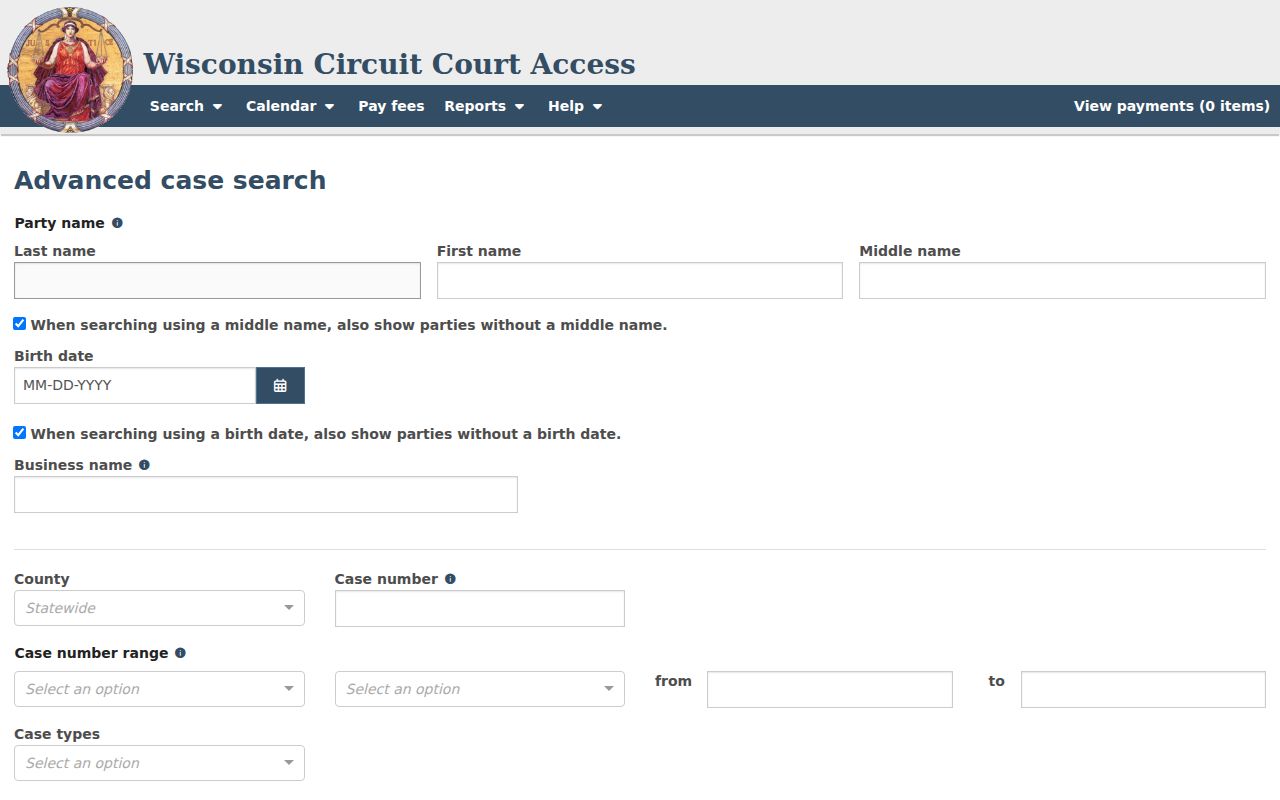
Start with one or two solid filters. Stack several uncertain values and the right Sauk County case may slip out of view.
How to Search by Case Number
A full Wisconsin Circuit Court number works best. A typical format looks like 2024CF000126. The first four digits are the filing year, two letters mark the case type, and six digits form the sequence, sometimes with leading zeroes added by WCCA. The letter codes break down simply: CF is criminal felony, CM criminal misdemeanor, CT criminal traffic, CV civil, FA family, SC small claims, PR probate, FO forfeiture, and TR traffic. Type the number into its own field. If nothing comes back, check every digit and letter. A citation number, a district attorney number, and a Circuit Court case number are three different things. Put the wrong identifier in the wrong box and the docket search returns nothing.
Sauk County Case Code Guide
These short codes keep unlike files apart when the same name repeats. CV and SC mean civil and small claims. CT and TR mark separate traffic groups. But the code alone never tells you the exact claim, charge, or outcome, so read the full type and class description.
- CF or CM
- Felony or misdemeanor.
- CV, SC, or FA
- Civil, small claims, or family.
- CT, TR, or FO
- Criminal traffic, traffic, or forfeiture.
- PR
- Probate, sometimes with added access limits.
Year and code can narrow a name search. Neither proves every page inside the file is open to the public.
What a Case Search Shows
A result row can carry the filing date, county, status, name, caption, and a birth-date field that may read "Date of Birth Sealed." Open the detail view. There you may find the branch, responsible official, parties, attorneys, cross-references, any charges, Court activities, Court record history, and a Filed documents index.
| Case number | A local key such as 2024CV000126. |
|---|---|
| Caption | The formal case title. |
| Status | Filed only, open, closed, or reopened. |
| Court activities | Event date, time, place, type, and official. |
| Court record | The dated docket history. |
| Filed documents | An index; an image is not assured. |
A complaint, a motion, a hearing, an order, and a judgment are separate events, not interchangeable labels. A closed case does not make every document public, and a filing is not proof of an allegation.
Sauk County Record Layers
Think in three layers. Search fields find the case. Court activities and Court record entries build the docket layer, while pleadings, motions, orders, exhibits, and transcripts form the file layer. WCCA shines in the first two. For inspection and copies of the public file, turn to the Sauk County Clerk of Courts. The official WCCA home shows the Circuit Court route.
A listed document with no downloadable image is normal. The index and the source file sit at separate layers.
County vs Statewide Case Search
Sauk County rides on WCCA rather than its own county database. If you do not know where the case was filed, search statewide. If the trial matter is local, select Sauk. Wisconsin appeals live on the separate WSCCA portal. Municipal ordinance cases stay with the municipal court printed on the citation.
| Route | Coverage | Best use |
|---|---|---|
| WCCA statewide | Wisconsin Circuit Courts | Unknown county |
| WCCA, Sauk filter | Sauk Circuit Court | Known local case |
| WSCCA | Wisconsin appeals | Appellate matter |
| Clerk | Public source file | Copies and certification |
For the file itself, call the Clerk, ask at the counter, or ask whether a mailed request works. WCCA does not replace any of that.
When Sauk County Searches Fail
A blank result does not mean no case exists. Check the spelling. Drop an uncertain middle name. Widen to statewide, or run the full number. For a business or group, try the business name field. Older records may never have been backloaded, and fresh events can take time to appear. Federal, appellate, municipal, juvenile, and sealed cases each follow other paths.
The official WCCA help page describes portal limits.
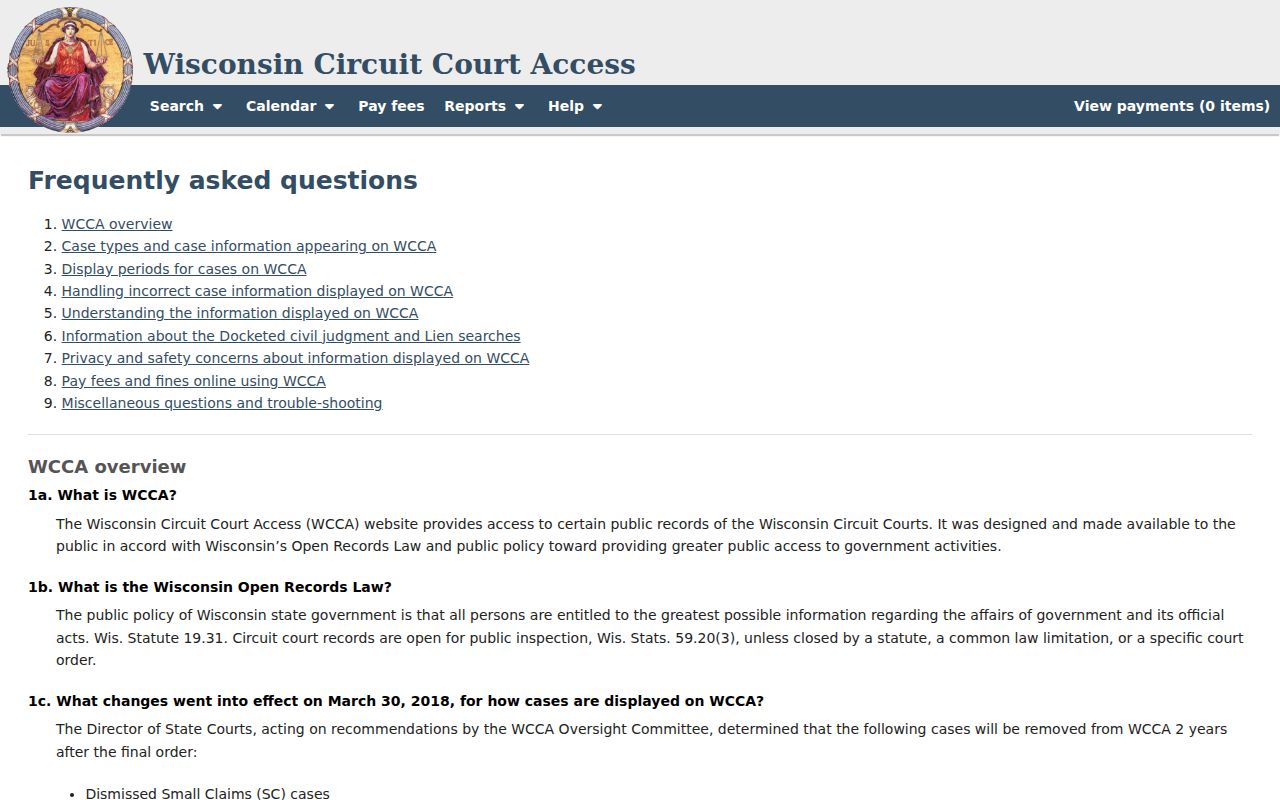
When the case shows but one document does not, ask about the public portion. Do not assume it is hidden or gone.
Restricted Cases and Access Rules
Wisconsin leans toward open access, but the door is not wide open. Some case types stay protected. Juvenile, adoption, parental-rights, guardianship, mental-commitment, sealed, expunged, and other protected matters may be missing or limited. Public results can mask a full birth date. Protected Social Security, tax, account, license, ID, or passport numbers get hidden too. Wisconsin Statutes §§ 801.19 through 801.21 control protected data, confidential filings, sealing, and redaction. Expect a blank result or a trimmed caption. You might see "Date of Birth Sealed," an index entry without an image, or redacted values. Confirm the right court and number first. Then contact the Clerk, or the Register in Probate and juvenile clerk where they apply. In the end, the law and the court's order decide access.
Sauk County Status Filters
WCCA sorts cases by status: Closed, Filed only, Open, or Reopened. These labels describe the portal, not the law. Filed only usually means the case is new. Open means it is still moving. Closed does not guarantee every duty is finished or every paper is public. Reopened tells you a closed case came back to life. For real answers, read the dated Court record entries. They show what actually changed.
Status works best as a filter. It clears away stale results when you want a current setting. It can also surface an old case when a name search gets crowded. Treat it as a tool, not an outcome. A dismissal, judgment, sentence, or satisfaction carries its own entry and its own meaning. Does a status clash with a recent notice? Verify the case number with the Sauk County Clerk or the assigned branch.
Jurisdiction matters too. A Sauk County ordinance citation might belong to a municipal court. It could be Baraboo Municipal Court, Reedsburg Municipal Court, or the joint Sauk Prairie Municipal Court instead of WCCA. Wisconsin appeals live on WSCCA. Federal cases go through PACER, which offers a free summary via MCVCIS. Lake Delton planning material points toward Circuit Court. The citation itself still decides the route. Check the named court first. That habit saves you from hunting in a system that never held the file.
Once you find the public summary, write down the county case number and the exact Filed documents description before calling. Clerk staff can then answer access questions. They can say whether the item may be inspected at 510 Broadway, requested by mail, or supplied as a plain or certified copy. A portal result cannot settle every access question. A public index, a docket event, and the source document are separate record layers.